

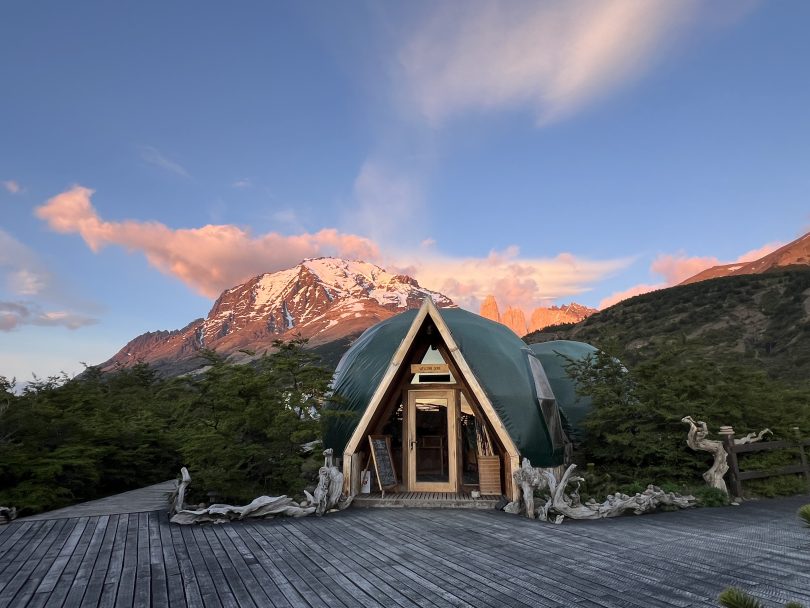

The setting could hardly be more magical: the vast Torres del Paine National Park in Chile, home to one of the most astonishing mountain ranges on the planet, immense ice fields, Patagonian steppes, and enchanting wildlife such as friendly guanacos and elegant pumas. But far beyond the landscapes, this is the story of an immersive journey that combines genuine sustainability with an invitation to connection — both human and with nature. For this reason, staying at EcoCamp Patagonia is a truly transformative and unforgettable experience. The kind that makes you want to come back again and again.
Since I founded Viajar Verde in 2015, EcoCamp Patagonia has been on my travel wish list because of its pioneering sustainable practices. Founded in 2001 by a group of friends who were adventure tourism guides and deeply committed to protecting this fragile region, it became the world’s first geodesic dome hotel. It was also the first hotel in Latin America to commit to so many responsible practices — initiatives that have earned numerous awards and inspired similar experiences around the world. These range from the dome structures, which require 30% less surface area for construction and 30% less energy to heat or cool, to composting toilets that are part of a system in which all waste is properly separated, treated, and disposed of — even in such a remote location.
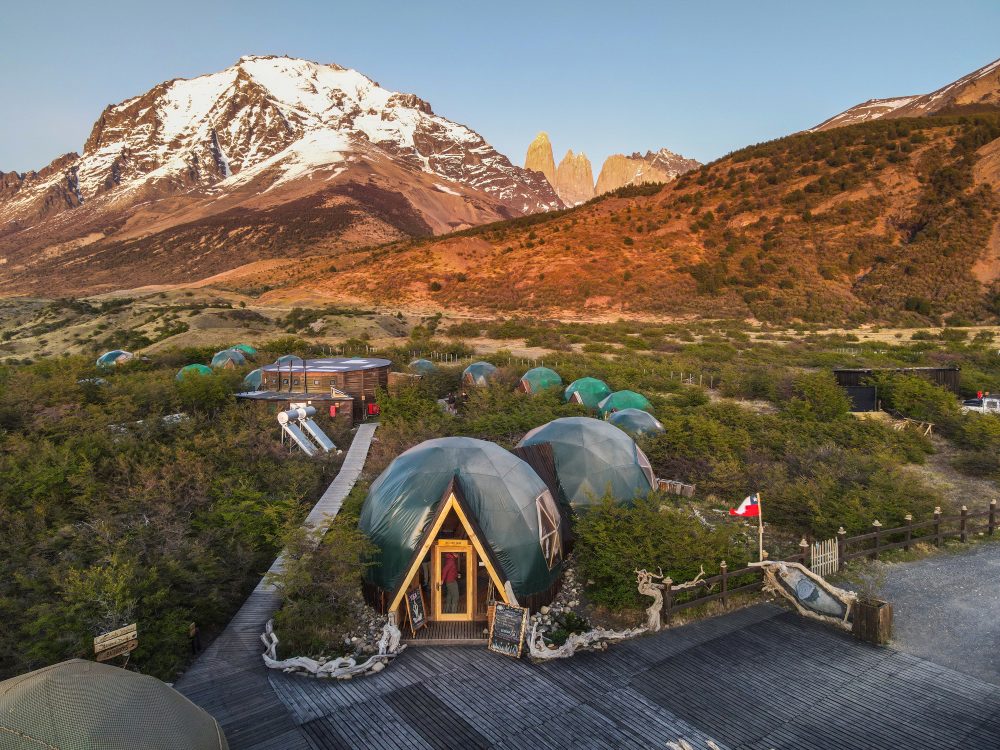
Photo: EcoCamp Patagonia
But don’t think that all of this reduces comfort. Quite the opposite! EcoCamp strikes the perfect balance between what we’ve been talking about so much lately: comfort, transformative experiences, and regeneration — with a healthy dose of adventure. It’s an experience where luxury lies in the details, such as the impeccable cuisine that celebrates local flavors and Chilean gastronomy (sustainably, of course), rather than in excess.
With the responsibility — and also the great privilege — of being located inside Torres del Paine National Park, the hotel takes its commitment to protecting this extraordinary place very seriously. The great purpose of EcoCamp Patagonia is to connect travelers with the essence of Patagonia — and with themselves.
Don’t be alarmed: to truly connect, you will be invited to disconnect from the outside world. There is no Wi-Fi, television, or other electronic distractions here. And if spending four or five days without internet access sounds a little intimidating, I can assure you that it was one of the best experiences I’ve had in recent years.
“We don’t have Wi-Fi, but you will find a better connection.”
— EcoCamp Patagonia
Everything at the hotel is designed to help guests connect in different ways, fostering a strong sense of community. In addition to the group excursions, where you’ll have the opportunity to interact and exchange experiences with people from all over the world, EcoCamp Patagonia has created wonderful communal spaces for other moments of sharing.
In the Community Dome, breakfasts, dinners, and activity briefings are shared with the groups you explore with during the tours. At the Bar, you can enjoy a drink or share moments of music and cultural performances with other guests. There is also the Yoga Dome, where stretching sessions and yoga classes are held collectively. And the best part is that the tour guides genuinely enjoy these moments with guests too. For an independent traveler like me, this was, without a doubt, a wonderful gift.
Above all, the hotel invites reflection. It’s impossible to leave without new thoughts — and perhaps even a few changes in attitude.
Base of the Towers | Photo: Ana Duék, Viajar Verde
A perfect day at EcoCamp Patagonia in Torres del Paine
EcoCamp welcomes guests with an Ecotour, designed to creatively present some of its initiatives related to innovation, environmental impact reduction, social commitment, cultural preservation, and destination regeneration. Few hotels dare to show their backstage operations. But when everything is done transparently — and with good reason to be proud — why not show it?
The domes are the iconic postcard image of EcoCamp and also its soul. The structures house not only the guest rooms but also the communal areas, the restaurant, the bar, the yoga room, and even the reception. Their inspiration comes from the Indigenous Kawésqar people, who once inhabited the region in dome-shaped shelters made from guanaco hides. The concept was also born from the desire to create a sustainable structure capable of withstanding Patagonia’s extreme climate. In addition to causing minimal environmental impact, the domes can be removed without leaving traces on the land — a simple and brilliant solution.
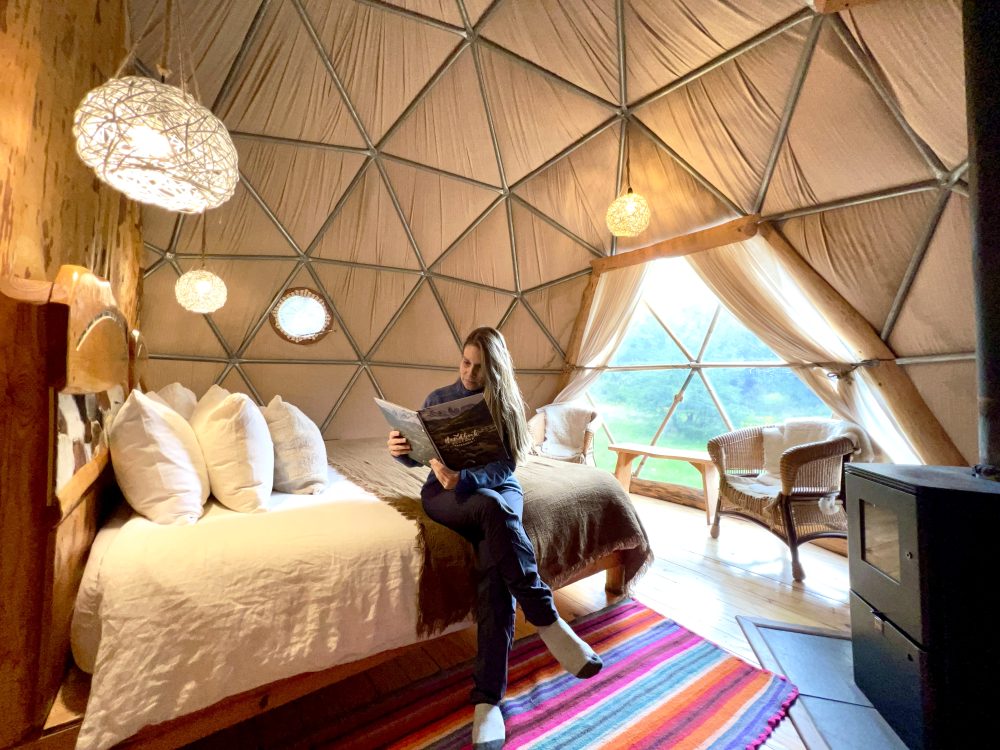
My dome at EcoCamp Patagonia | Photo: Ana Duék, Viajar Verde
Upon arrival, guests are invited to plan the activities for the coming days together with the team. Each evening before dinner, the group gathers with the guide in the Community Dome for a briefing, where everyone receives information about schedules, recommended clothing, and what to expect from the next day’s experience. Between snacks and drinks, this is also a lovely opportunity to get to know the other travelers and exchange stories from the day.
Days at EcoCamp begin early, with a generous buffet-style breakfast. Everything is very fresh, and much of the food is prepared right there, such as the homemade breads and cakes that come out of the kitchen warm and fragrant. At the communal tables, you have the chance to interact with the companions of your day’s activity.
Since most activities last the entire day, at breakfast we receive a reusable lunch box to prepare our own packed lunch. Among the salads, wraps, sandwiches, nuts, and sweet treats available at the buffet, each guest chooses what they want to take along. In addition to being practical, the system helps avoid food waste and encourages us to take only what we truly need for the trail.
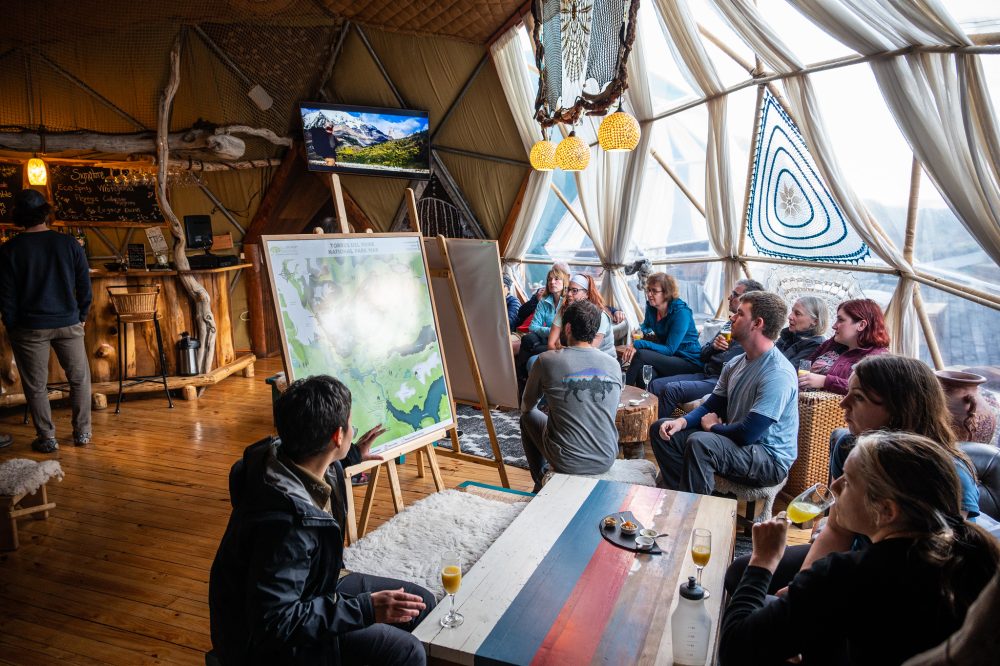
Community Dome | Photo: EcoCamp Patagonia
After returning from the day’s activities, we head to a class in the Yoga Dome. I was exhausted and hesitated, but believe me: it was the best decision I made after hiking to the Base of the Torres del Paine. The next day, I woke up feeling completely refreshed, without any soreness. The days fly by, and soon it’s time to shower and head to the next activity briefing before dinner.
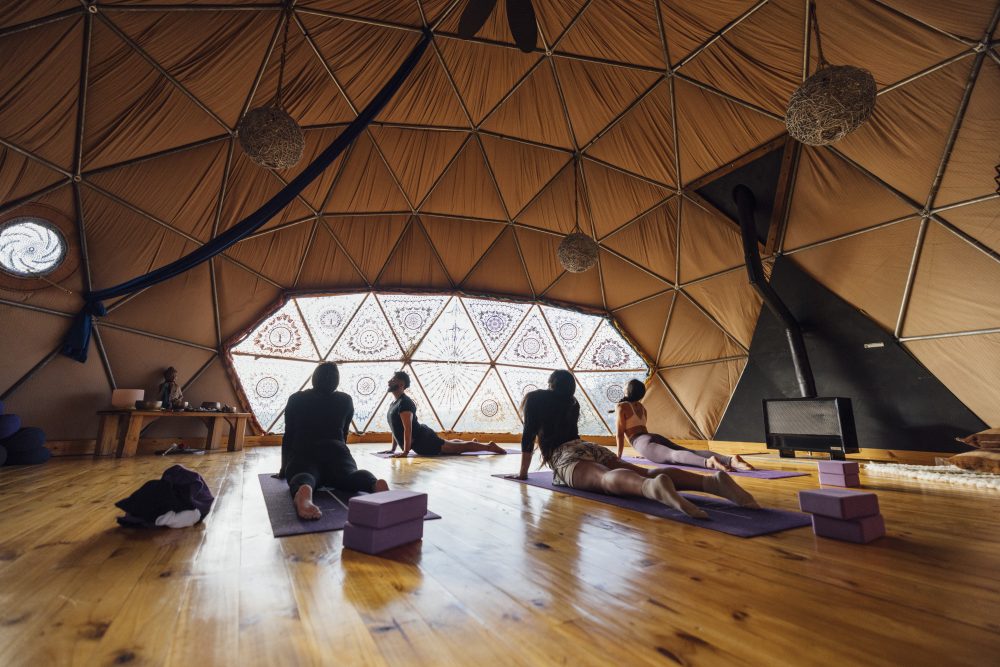
Yoga Dome | Photo: EcoCamp Patagonia
You’ll quickly notice that food receives special attention at EcoCamp, and dinner is undoubtedly one of the highlights of the experience. The kitchen prepares dishes full of flavor and care, using local ingredients while celebrating Patagonian and Chilean cuisine, always with excellent vegan and vegetarian options. Sustainability is also central to the gastronomy, through practices such as minimizing waste, sourcing from local producers, and growing some ingredients on site.
More than just a meal, dinner feels like a warm embrace after a day immersed in nature — proof that eco-gastronomy can be incredibly delicious too.
Activities in Torres del Paine National Park and surroundings
Activities are the foundation and essence of the EcoCamp experience. They are thoughtfully designed so travelers can truly connect with Patagonian nature and culture. With highly trained guides, strict safety protocols, activities for different levels of physical ability, and small groups, the experiences are both immersive and safe.
Depending on the itinerary chosen, all activities may already be included in the package. More adventurous travelers often opt for the challenging W Circuit (5 or 7 days), while wildlife lovers may focus on the Patagonia Puma Tracking experience.
My itinerary was the Wildlife Safari (which can last between four and seven days), ideal for those who want to explore several areas of Torres del Paine National Park and its surroundings through different activities each day. EcoCamp offers an incredible menu of experiences that includes iconic hikes and lesser-known trails, as well as a day at a traditional estancia, a visit to Grey Glacier, and boat excursions. In other words, while adventure is the main focus, there are options for travelers with varying levels of physical preparation.
Trekking to the Base of the Torres del Paine
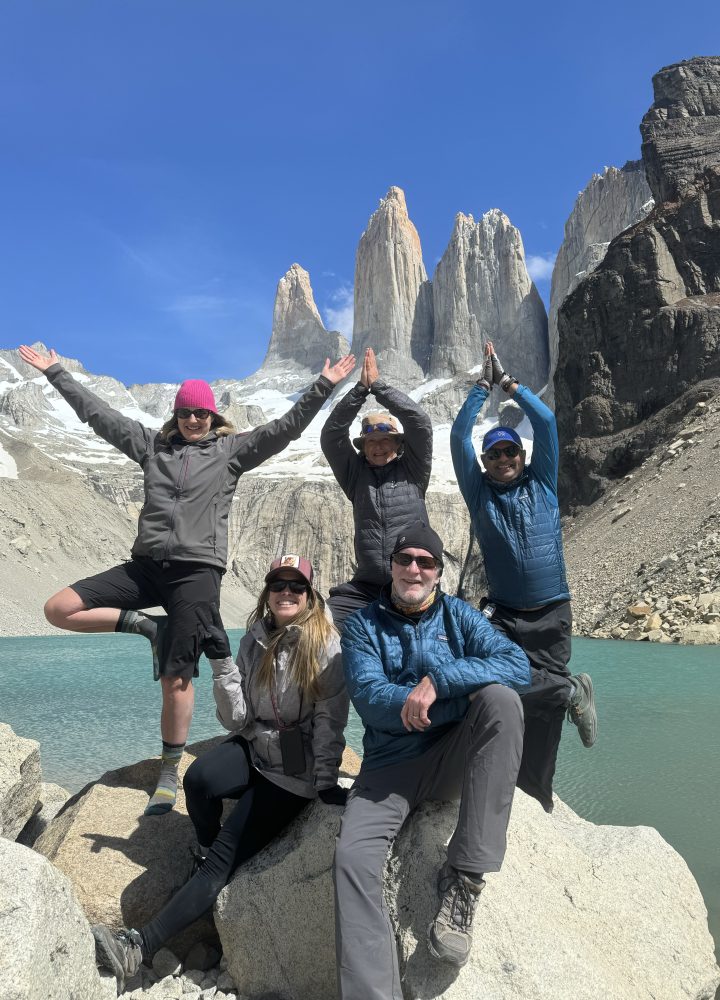
On my first day of adventure, I hiked to the Base of the Torres del Paine — one of the region’s must-do experiences and also one of its most challenging day hikes. The trail is 22 km round trip, with several steep sections. During the long initial climb, I even considered giving up when I realized there were still more than 16 km ahead. But every bit of effort is rewarded by the breathtaking landscapes along the way, and especially when you reach the base of the famous towers, rising above a lagoon of turquoise water.
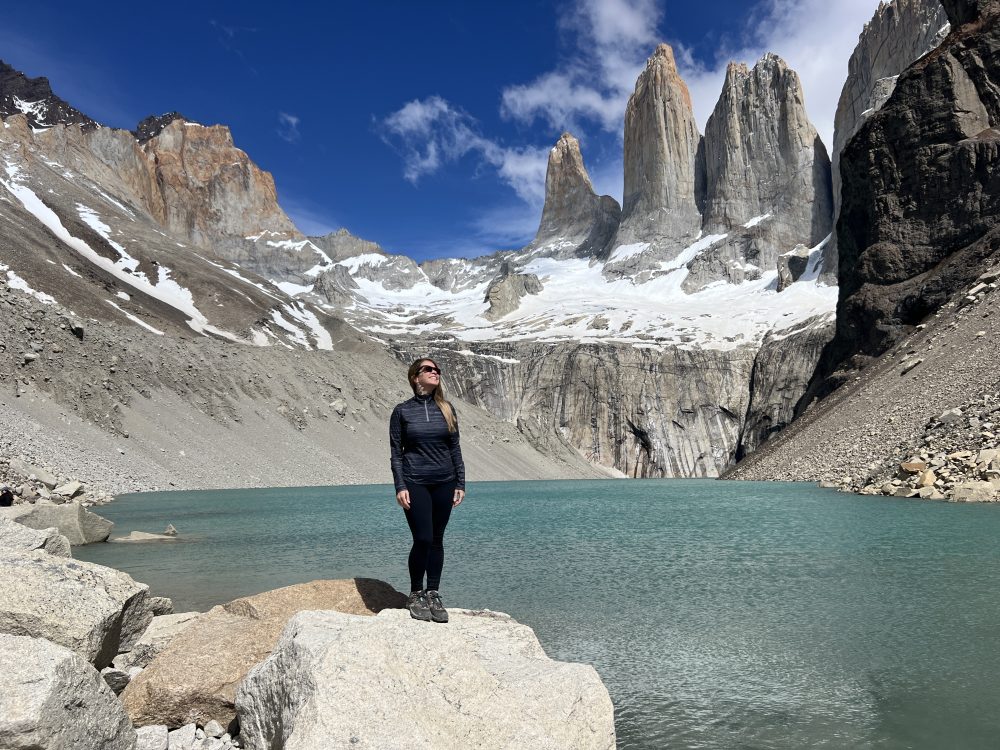
Base of the Towers | Photo: Ana Duék, Viajar Verde
One of the most remarkable aspects of starting this hike from EcoCamp Patagonia is that the trek begins inside Torres del Paine National Park itself. In addition to avoiding the roughly two-hour drive from Puerto Natales, EcoCamp is located practically at the start of the trail, saving about another kilometer compared to those who begin at the visitor center. Because we wake up early, we are also among the first to reach the towers.
The entire hike took us almost ten hours (some people complete it in eight), with strategic stops for rest, snacks, and plenty of photos. We were incredibly lucky with the weather — one of Patagonia’s greatest challenges — and saw the towers completely free of clouds, framed by a brilliant blue sky. What an honor!
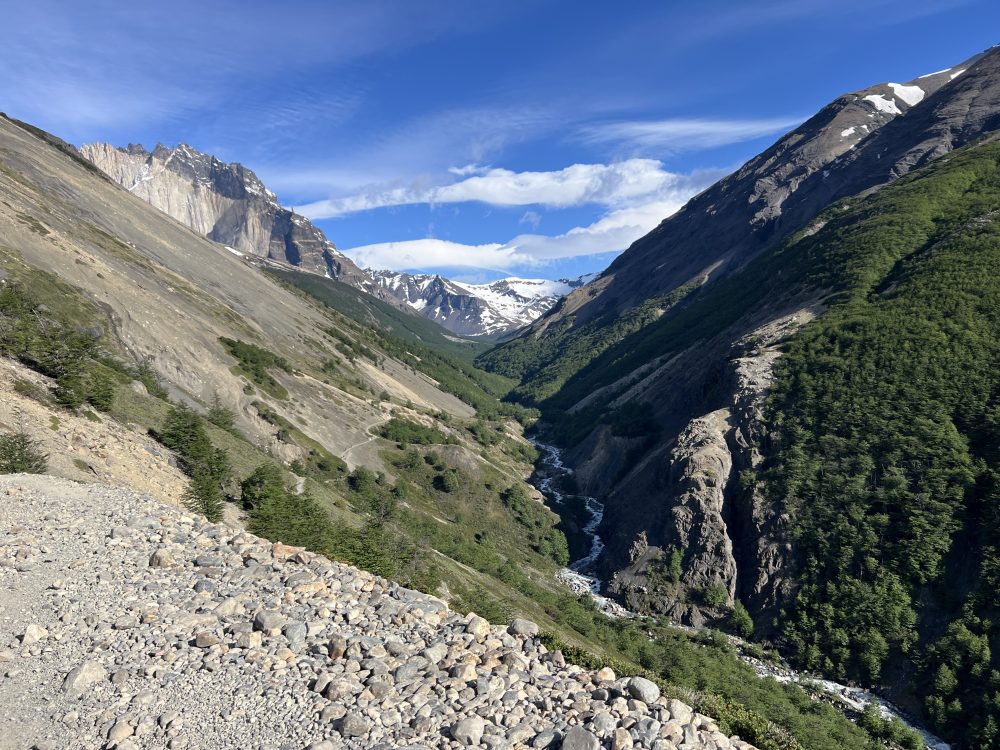
Hike to the Base of the Towers | Photo: Ana Duék, Viajar Verde
Mirador Cuernos Trail
On the morning of the second day of activities, I chose to hike to Mirador Cuernos, a shorter walk with almost no elevation gain but extremely rewarding. The trail covers 6.4 km (round trip) and is considered moderate. The route begins at Salto Grande, an impressive 15-meter-high waterfall, and ends at a panoramic viewpoint with spectacular views of the Cuernos del Paine, Lake Nordenskjöld, and the French Valley.
At first, the trail may seem a bit unremarkable, but it gradually reveals its charm along the way. We observed several flowers typical of the Patagonian steppe, crossed diverse and beautiful landscapes, and experienced some of the region’s famous wind. The final reward is a privileged view of some of the most impressive peaks of the Paine Massif, the Cuernos (Horns) del Paine.
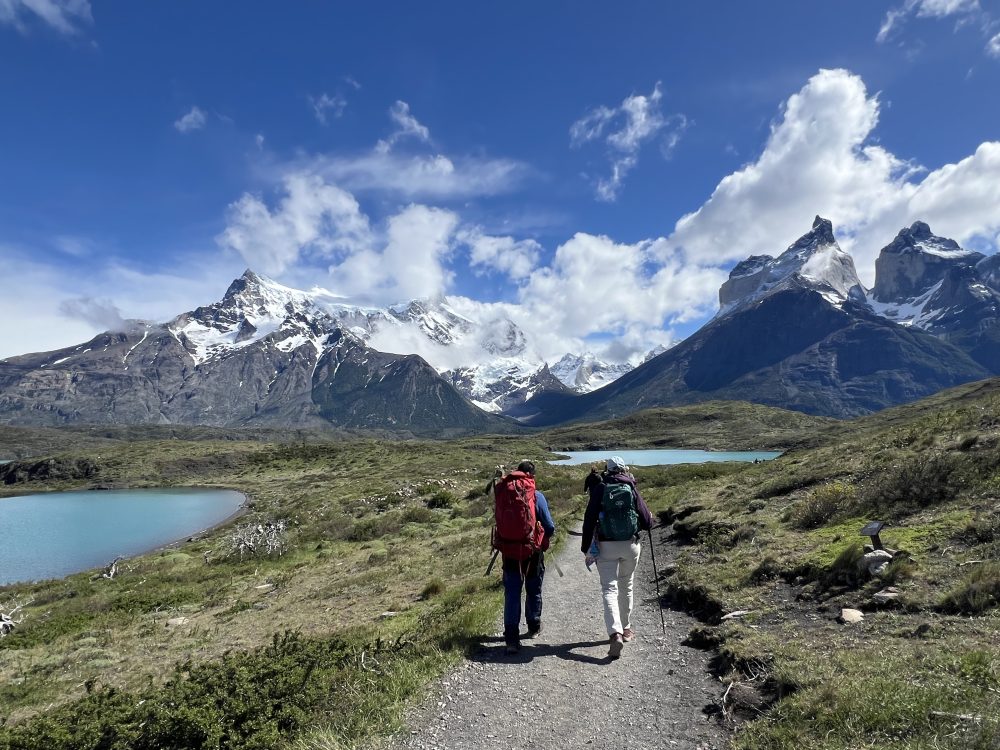
Mirador Cuernos Trail | Photo: Ana Duék, Viajar Verde
Mirador Cóndor Trail
After lunch, we set off for the Mirador Cóndor trail, a short hike with a steady climb that gets your heart racing within the first few minutes. The path follows an open hillside with little vegetation, offering expansive views almost the entire way. As we gain elevation, Lake Pehoé appears in intense shades of blue, contrasting beautifully with the peaks of the Paine Massif in the background.
The trail is short (2.6 km round trip), but the steep ascent, the Patagonian wind, and the fatigue from the previous day make it more challenging than it seems. At the top, the effort is quickly rewarded with a 360-degree viewpoint revealing some of the most iconic landscapes of Torres del Paine National Park. From here, it’s possible to see Lake Pehoé, Lake Nordenskjöld, and once again the Cuernos del Paine. The trail’s name is no coincidence: this is the perfect place to spot the majestic Andean condor, and we were lucky enough to watch two of them soaring high above us.
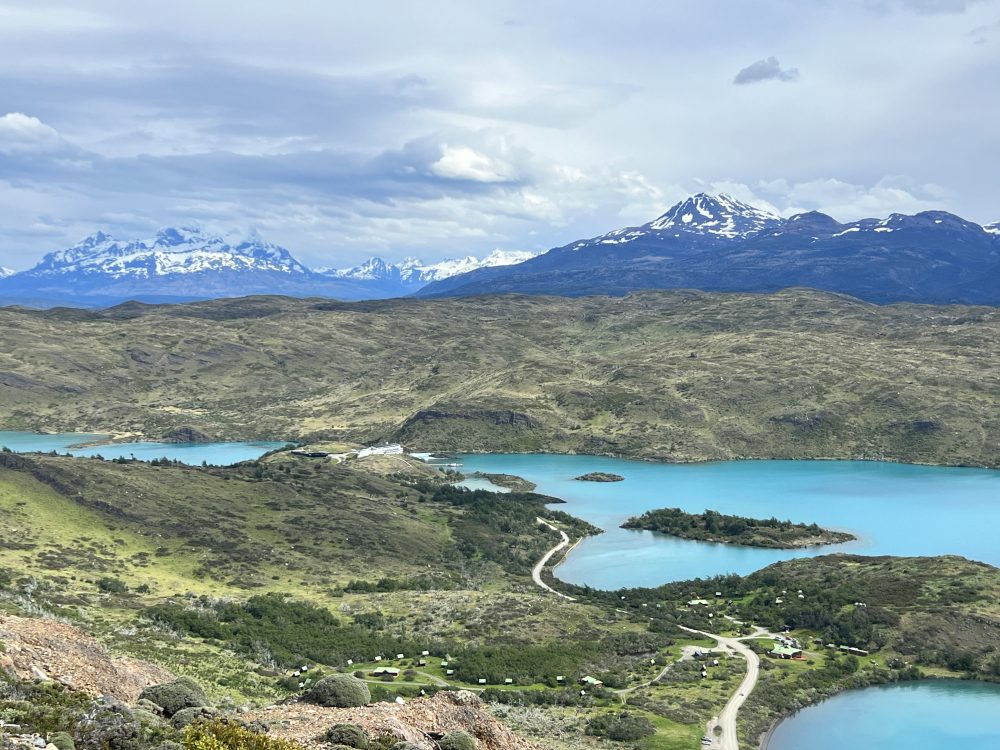
Mirador Condor Trail | Photo: Ana Duék, Viajar Verde
Sustainability practices that make EcoCamp a pioneer
In an interview with Mike and Anne Howard of Honey Trek, EcoCamp’s founders explained:
“At EcoCamp, sustainability isn’t a marketing angle; it’s literally the foundation we were built on. From day one in 2001, EcoCamp was created as a low-impact project inside a vast and fragile ecosystem. This early design decision guided everything; it allowed us to set the environmental standard to which guests adapt, rather than adapting our operation to traditional notions of comfort. Over the years, many camps around the world have drawn inspiration from EcoCamp’s dome architecture. But few understood what truly mattered: the environmental design philosophy behind it. The domes are just the aesthetic expression; the real innovation is how lightly they allow us to live on the land.”
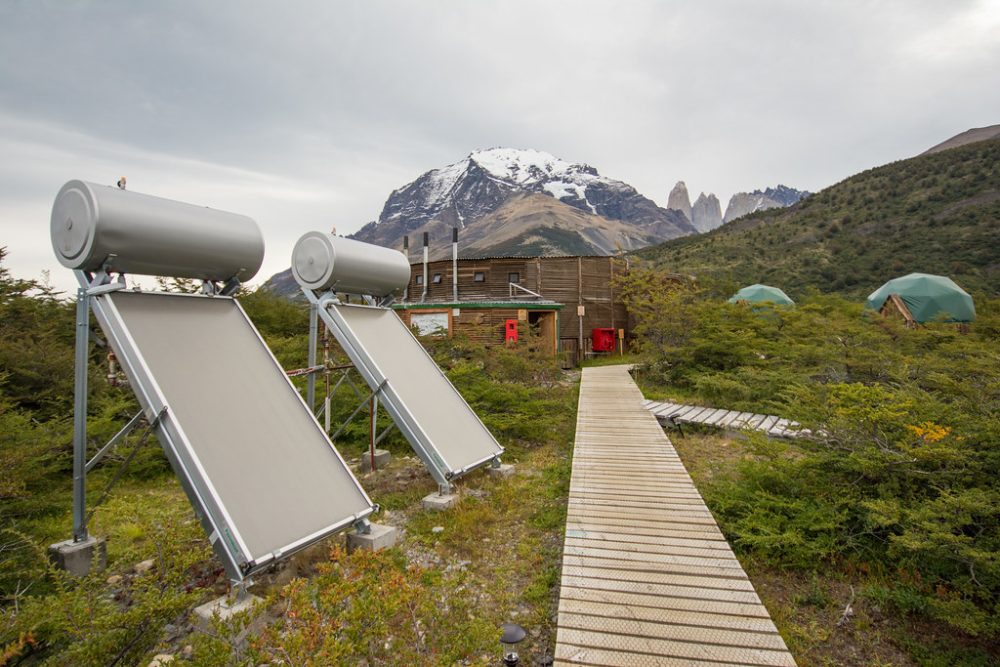
Discover some of the sustainability practices that continue to make EcoCamp a global pioneer in responsible tourism:
🌿 Low-impact architecture: The domes and elevated walkways are designed to interfere as little as possible with the surrounding environment, allowing soil and vegetation to regenerate naturally.
☀️ Renewable energy: Nearly 100% of the hotel’s energy comes from clean sources such as solar panels and a small hydroelectric system.
🚽 Composting toilets: EcoCamp uses dry composting toilets that transform waste into organic compost, turning human waste into fertilizer.
♻️ Responsible waste management: Waste is minimized, separated, and properly treated. Organic waste is composted and recyclables are sent to recycling partners.
🔄 Circular reuse of materials: Old uniforms, towels, and curtains are repurposed or transformed into new products, extending the life cycle of materials and reducing waste.
🚫🥤 Zero single-use plastic policy: The use of disposable plastics has been almost entirely eliminated. During hikes, guests receive reusable lunch boxes and are encouraged to use their own refillable water bottles.
🥕 Sustainable gastronomy: The restaurant prioritizes local and seasonal ingredients, either produced on-site or sourced from regional producers. Plant-based foods are valued, and efforts are made to reduce food waste.
🤝 Commitment to the local community: Much of the staff comes from nearby towns such as Puerto Natales and Punta Arenas, and the hotel prioritizes regional suppliers, helping strengthen the local economy.
🧶 Support for regional craftsmanship: Decorative items and souvenirs sold at the hotel are produced by Patagonian artisans, helping preserve traditional knowledge and generate income for local communities.
🌎 Socio-environmental partnerships: EcoCamp collaborates with conservation and environmental education projects, while also supporting restoration and clean-up initiatives within the park.
♿ More inclusive tourism: In partnership with organizations such as Wheel the World, the hotel offers adaptive equipment like the Joëlette trail chair, allowing travelers with disabilities to explore the park.
🇨🇱 Cultural preservation: Through experiences and storytelling, guides share the history of Patagonia, introducing guests to local traditions, the culture of the baqueanos (Patagonian horsemen), and the region’s Indigenous roots.
More than just a sustainable hotel, EcoCamp Patagonia has helped redefine what it means to stay in one of the most remote and extraordinary places on the planet — consciously and with minimal impact. Rather than adapting nature to traditional expectations of comfort, the philosophy has always been the opposite: inviting visitors to slow down and adjust their rhythm to that of the land. The result is an experience that proves it’s possible to travel, be deeply moved, and at the same time help protect the very places that make these journeys so extraordinary.
Check out: The Eco Secrets Of One Of The World’s Most Sustainable Hotels
How to get to Torres del Paine and EcoCamp Patagonia
EcoCamp Patagonia is located inside Torres del Paine National Park, in southern Chilean Patagonia. The easiest way to reach the park is by flying from Santiago to either Punta Arenas or Puerto Natales, the gateway town to Torres del Paine located about two hours away. Both cities receive regular domestic flights.
From there, the journey continues by road to the park. To make the logistics easier, EcoCamp offers ground transfers, picking guests up directly from their hotel in Punta Arenas or Puerto Natales and taking them to the lodge inside the park.
Best time to visit Torres del Paine
EcoCamp Patagonia typically operates between September and early May. During the Patagonian winter (May to August), many hotels and services close due to the intense cold and the logistical challenges of operating inside Torres del Paine National Park.
High season (summer) runs from December to February, when the days are longer, though winds can be stronger and trails busier. For a quieter experience, consider visiting in October and November or March and April, when the park is usually less crowded and the landscapes are spectacular — with wildflowers in spring or golden hues in autumn.
Because demand is high and the number of domes is limited, it’s best to book well in advance to guarantee availability.
I traveled as a guest of EcoCamp Patagonia.

